Winslow Homer
Available Works
Biography
Winslow Homer (American, 1836-1910) is a renowned painter known for his impressionistic glimpses into the New England landscape. Homer began his career as a printmaker and illustrator, documenting the civil war and its veterans for the early part of his career, before eventually turning to landscape portraits of New England. In New England, Homer was drawn to coastal scenes and glimpses into the everyday lives of sailors and workmen, often in watercolor. During a brief trip to Paris in 1866, Homer interacted with the French impressionists and avant garde while showing at the Exposition Universalle. Upon his return to the United States, Homer began to embrace the subject matter and simplicity of the two movements while applying these influences to landscape and portraiture of New England.
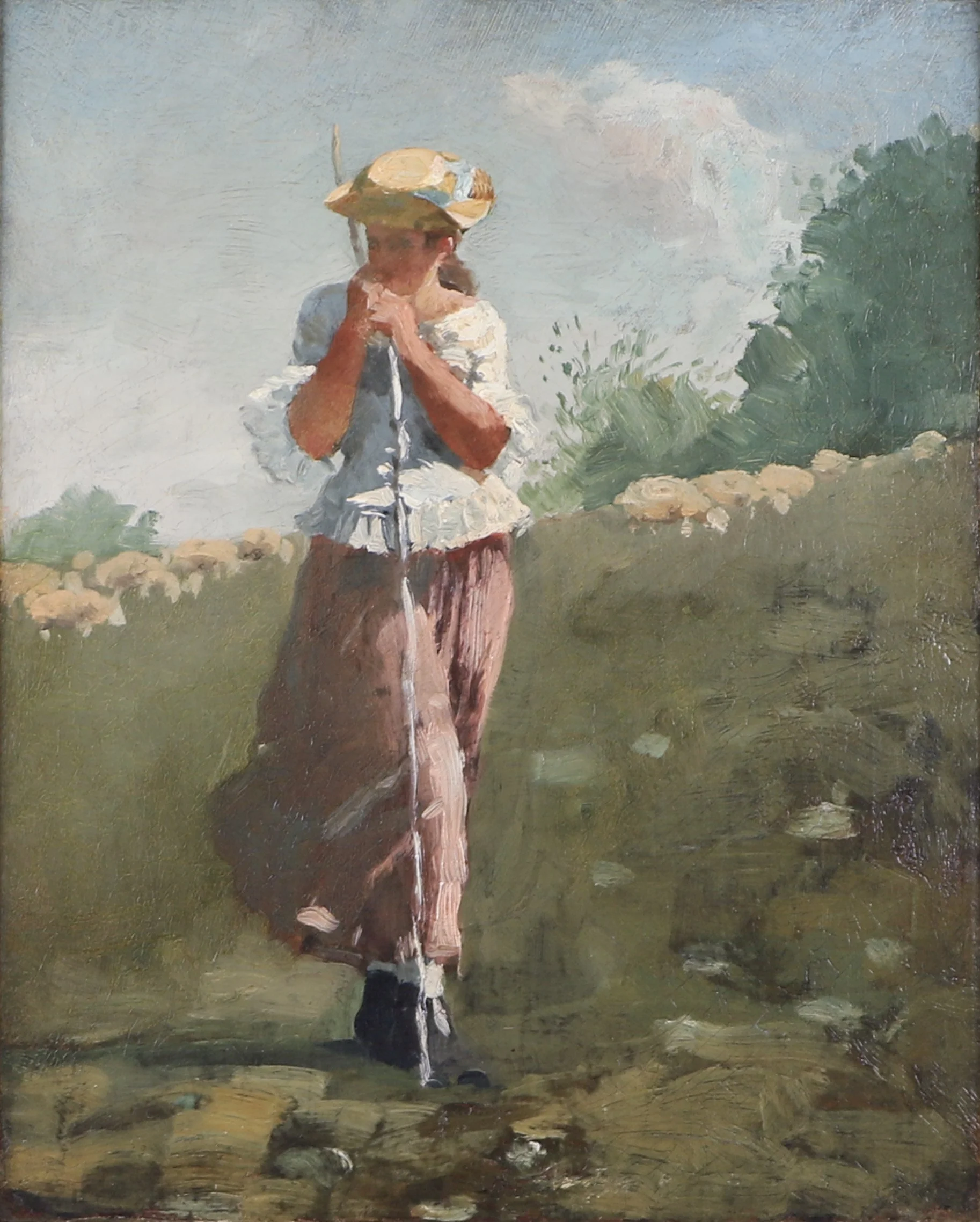
Throughout his career, Homer depicted both the landscapes and people of his many travels. In the summer of 1878, while visiting his friend’s farm in Mountainsville, NY, Homer took to painting pastoral images of women. These shepherdesses would become some of Homer’s most revisited subjects in a variety of sketches, watercolor paintings, and oil paintings. The Shepherdess is a result of a litany of sketches and revisions by Homer. During his time in Mountainsville, Homer would create many sketches of a variety of compositions, some leaning more into the landscape of the pasture, others the subjects, others the scene as a whole, including the animals and foliage. After returning to New York, Homer would revise early renderings to alter the composition to his liking. One such work, perhaps a draft for an engraving in the 1880 Art Journal, would focus less on the landscape and more on the Shepherdess herself. In 1879, Homer would present an additional Shepherdess work, perhaps a further rendering of an earlier pastoral sketch, titled Spring: The Shepherdess of Houghton Farm at the National Academy of Design. In The Shepherdess of Houghton Farm Homer paints the shepherdess in classical proportions, a further evolution of his original sketches and works from his time on the farm.
The Shepherdess posits itself as a key work in the evolution of Homer’s shepherdess works. An oil painting, Homer marries the keen attention to the subject’s frame as she rests on the staff, her clothes billowing with the wind, with impressionistic, broad strokes defining the landscape behind her. It is clear that the shepherdess is the main subject of the composition, not only through hierarchical scale but also the keen attention to detail Homer has applied to her clothes and posture. She is placed within a beautiful impressionist landscape with painterly sheep grazing along the tree line behind her.
Homer would spend the later years of his career living in Maine, continuing to paint pastoral and coastal scenes, before his death in 1910. Homer’s renowned works are in the collections of major museums through the United States and abroad, including at the Museum of Fine Arts, Boston, MA, The Metropolitan Museum of Art, New York, The National Gallery of Art, Washington, DC, and The National Gallery of Art, London, UK, among countless others.