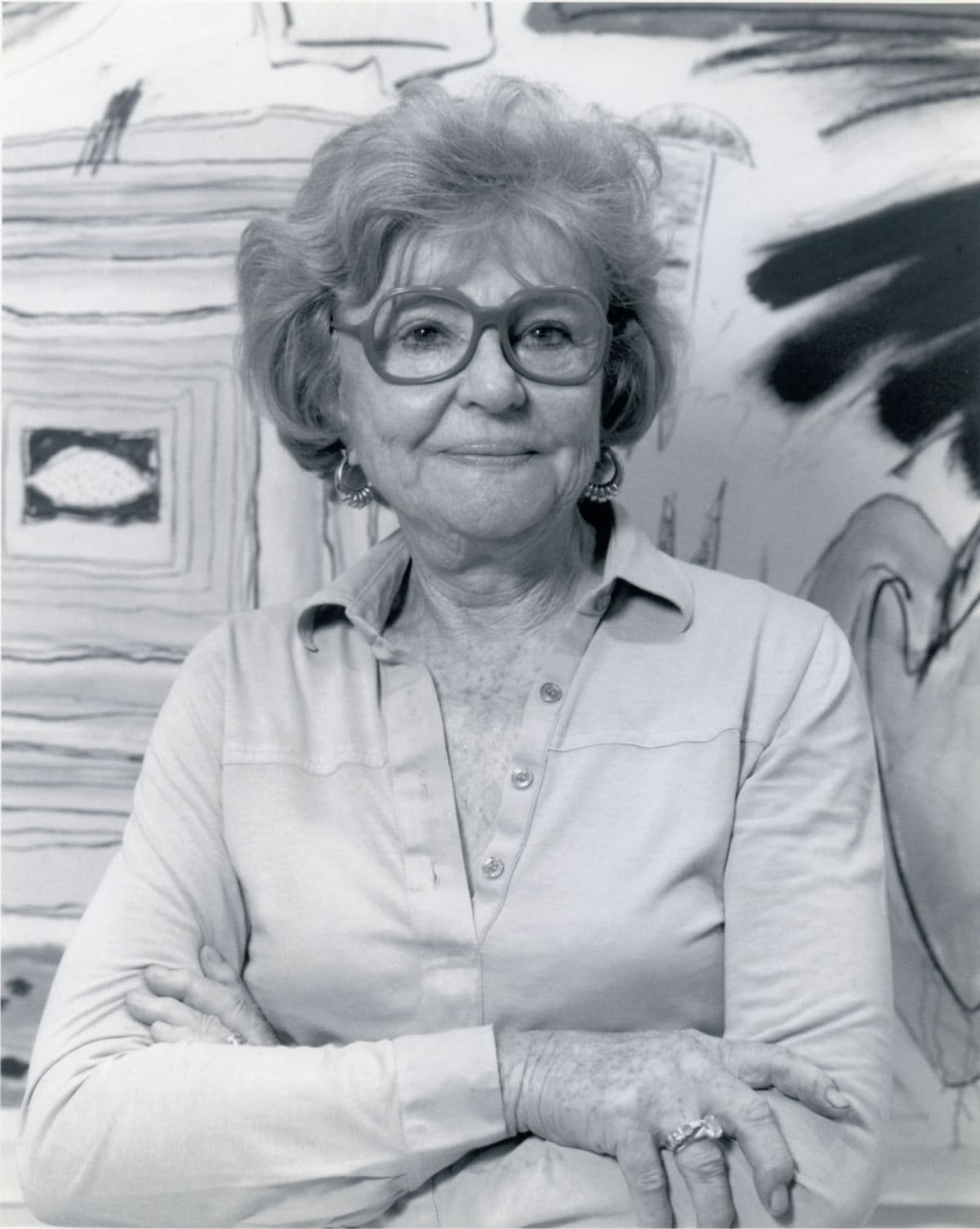
Ida Kohlmeyer was an American painter and sculptor widely regarded as one of the most important contemporary artists from Louisiana and the American South. She is best known for her Abstract Expressionist paintings of colorful glyphs composed in grids. Kohlmeyer lived in New Orleans for her entire life.
Kohlmeyer was born in 1912 in New Orleans to Polish immigrants Joseph and Rebecca Rittenberg. She graduated from Newcomb College at Tulane University in 1933 with a degree in English. She married Hugh Kohlymeyer shortly after graduating, and the two honeymooned in Vera Cruz and Mexico City, Mexico. It was on this trip that Kohlmeyer was first introduced to Mexican folk art and ceramics, which she would later collect and from which she would take inspiration.
Kohlmeyer first started making art as an adult, taking her first art classes at the John McCrady Art School in the French Quarter of New Orleans in 1947. She pursued an MFA from Newcomb College from 1950-1956. While she was a student, her work was mostly figurative studies of children and other representational studies. Kohlmeyer went on to teach art at Newcomb College from 1956 to 1964 and at the University of New Orleans from 1973 to 1975 while working out of a home studio. After earning her MFA, she spent the summer of 1956 at the Provincetown, Massachusetts art colony at the suggestion of Clyfford Still. While there she studied under Hans Hofmann and first began experimenting with abstract painting. Kohlmeyer referred to her turn towards abstraction as a “great awakening” and likened it to being freed from prison. Later that year she met Spanish artist Joan Miró in Paris, and through their conversation she was inspired to create her own code of schematic symbols, which she would arrange in a grid pattern in paintings throughout her career. Her transition into abstraction was further aided by Mark Rothko’s tenure as the visiting studio artist at Tulane in 1957. Kohlmeyer hosted Rothko in her family home in Metairie, and the abstract painter created some of his most pivotal works in the studio he set up in the garage there. Her exposure to Still, Hoffman, Miro, and Rothko heavily influenced her work.
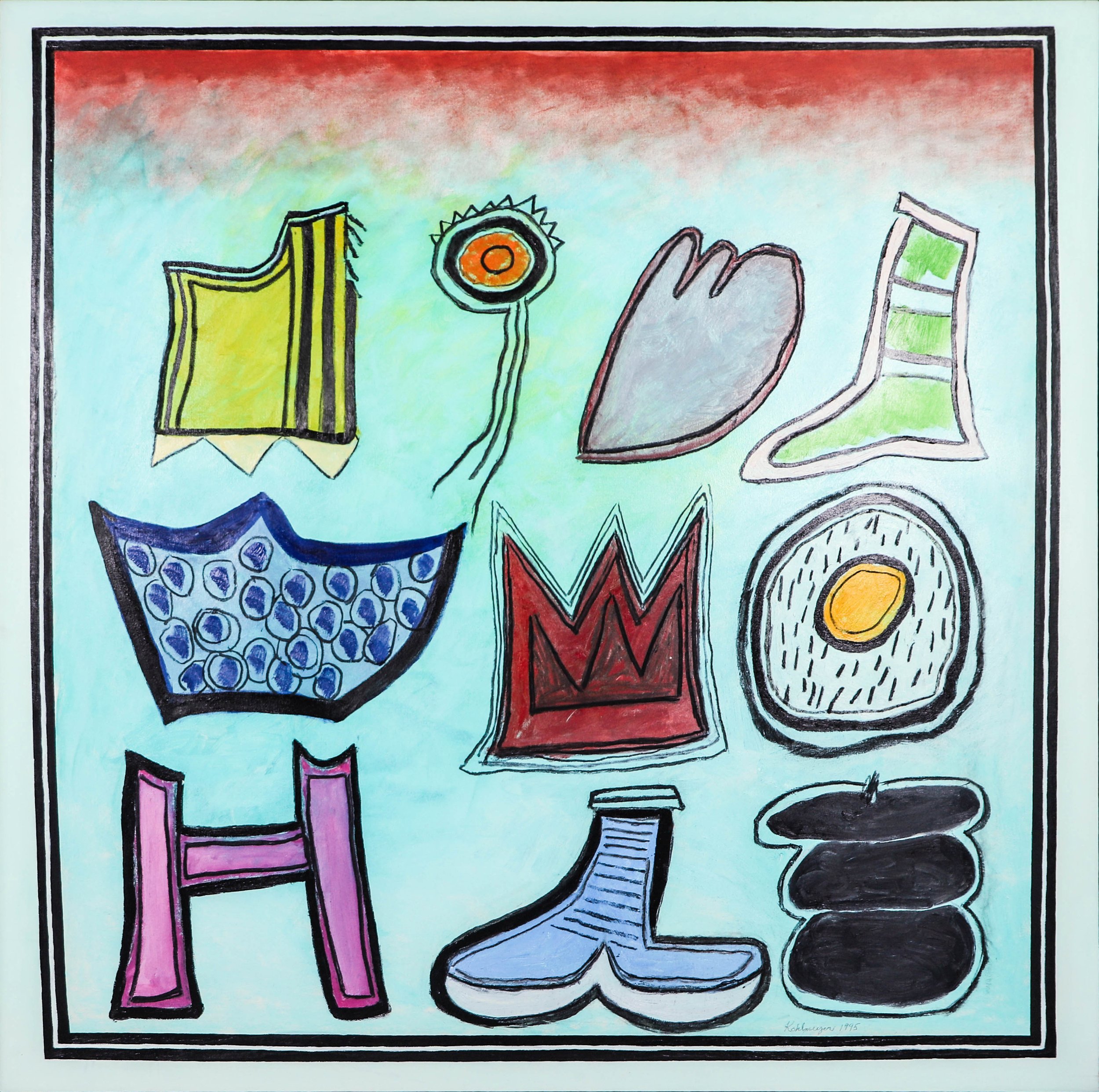
Composition 95-11
Kohlmeyer’s forays into abstraction were quickly rewarded, with her first national gallery show at the Ruth White Gallery in Manhattan in 1959. She had work in a show curated by Clement Greenberg in 1961 at the Oklahoma Art Center in Oklahoma City and was represented in the 28th Biennial of Contemporary American Painting at the Corcoran Gallery in Washington, DC in 1963. By the 1970s she had abandoned figural elements completely.
Her “Clusters” series in the 1970s evolved out of a move away from a gestural approach to painting, instead favoring stacked and striated lines of vivid color in loose geometric compositions. These paintings culminated in checkerboard-like works with each square containing a freely rendered shape with symbolic associations. The “Clusters” series led directly into her “Synthesis” paintings in the 1980s, in which she abandoned the backing grid and allowed her glyphs to float in atmospheric space. A sub-series within “Synthesis” were the “Mythic” paintings, which introduced new symbolic elements of balls, arrows, and abstract forms suggestive of architecture and landscapes. Through the 1990s until her death in 1997 Kohlmeyer revisited all of the symbolic elements throughout her career, depicting her abstract glyphs and symbols in complex spatial arrangements. In the mid-1990s she applied a new flatness to her paintings, making her colors brighter and her forms bolder and more defined on both open and gridded backgrounds. With their greater focus on pattern and decorative motifs, these later works are associated with the New York Pattern and Decoration movement from the early 1970s. At the height of her career Kohlmeyer’s work was the result of years of self-examination and reduction of forms, speaking to the arbitrary nature of symbols and a universal human desire for communication.
Sculpture was a significant part of her practice from the late 1960s, with her compositions in wood and plexiglass with painted surface patterns complimenting her two-dimensional paintings. In the 1980s she transitioned to rendering soft sculptures of bundled silkscreen fabric set in plexiglass boxes. Throughout the 1980s she worked with fabricators to render glyph shapes similar to those in her paintings into three-dimensional sculpture, acclaimed for their bold colors, striking profiles, and playful forms. In 1990 she completed her largest installation for the Audubon Aquarium of the Americas in New Orleans. She passed away on January 29th, 1997, at Touro Infirmary in New Orleans
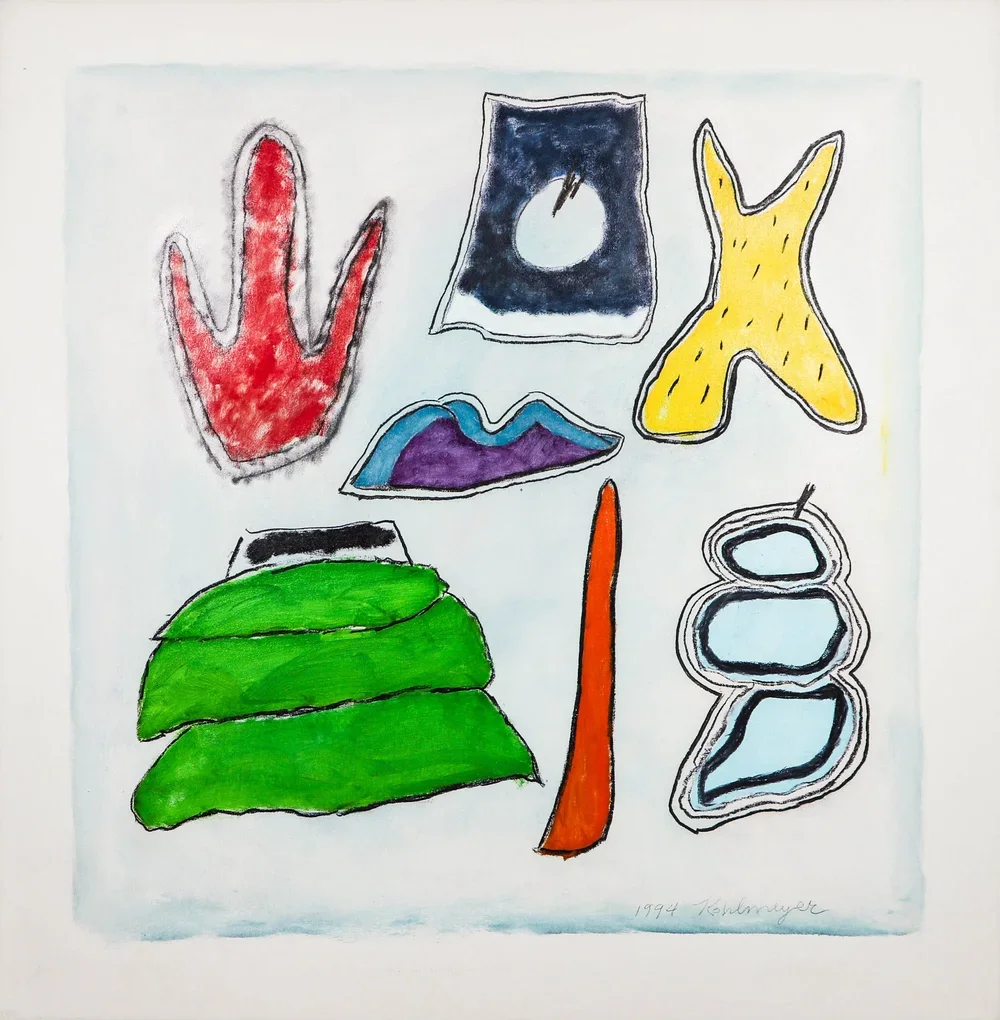
Composition 94-27